up:: Systems MOC
owner:: @Niko
intent: living-doc
llm: update-in-place
scope: team
Pool maintenance SOP — chemistry targets, weekly routine, backwash procedure, seasonal cycle. "Pool Masters" rotate. Daily expectations → Agorideans - Chores.
260521 revision — chemistry targets aligned with TFP (Trouble Free Pool) ABC method + Reno climate. Adds full testing protocol (FC/pH/TA/CH/CYA), winterization, plaster strategy, future-improvements pathway. Source: WebSearch synthesis 260521.
260811 revision — Pool RX committed as the standing mineral system (ionizer alternative evaluated and rejected); 261114 booster/discontinue decision resolved toward renewal, with staining/resurface safety-valves retained.
Pool Specs
- Dimensions: 18' × 36' rectangular, 3.5' shallow → 10–10.5' deep end
- Volume: ~30,000 gallons (working estimate; Pool Math app refines via slope geometry)
- Surface: plaster — old, chipped in multiple places (#Plaster Condition)
- Filter: sand
- Sanitizer: traditional chlorine (liquid recommended; see #Future Improvements)
- Algae/mineral assist (committed system): Pool RX chelated-copper cartridge — our chosen mineral system (owner decision 260811; a solar copper/silver ionizer, e.g. Sun Shock, was evaluated and rejected — Pool RX's chelation means lower staining risk on our chipped plaster). Current cartridge installed 260514, 6-month cycle through ~261114; renew with booster at cycle end. See #Pool RX — Current Cycle.
- Location: Reno NV — high desert (high UV, hard source water, freeze winters)
Goals
- Sanitized water (FC within target band per CYA)
- No algae bloom
- Slow further plaster degradation
- Swimmable Memorial → Labor Day; opened/closed bookending the freeze window
Chemistry — Target Ranges
Plaster pool, traditional chlorine, Reno climate:
| Variable | Target | Notes |
|---|---|---|
| FC (free chlorine) | per CYA chart below | the master variable |
| pH | 7.6–7.8 (aim 7.7) | high CO2 loss in dry climate pushes pH up |
| TA (total alkalinity) | 60–80 ppm | lower end with liquid chlorine reduces pH drift |
| CH (calcium hardness) | 250–500 ppm | plaster requires ≥250 to prevent further etching |
| CYA (stabilizer) | 30–50 ppm | UV burns ~10 ppm/month → top up monthly |
FC depends on CYA
| If CYA = | FC minimum | FC target |
|---|---|---|
| 30 | 2 | 4 |
| 40 | 3 | 5 |
| 50 | 4 | 6 |
Below FC minimum → algae growth risk. Above target → wasteful but harmless.
Pool Math app (TFP) automates this math: input current readings → app calculates exact chemical doses for our 30k-gal volume. Free on iOS + Android. Strongly recommended — replaces manual conversion tables.
Testing Protocol
Test kit: 5-reagent kit covering FC + pH + TA + CH + CYA ✓ all bases covered.
Frequency:
| When | Test |
|---|---|
| Summer, every 2–3 days | FC + pH (quick check) |
| Summer, weekly (Sundays) | Full panel — FC + pH + TA + CH + CYA |
| Off-season, weekly | Full panel |
| Monthly | CYA recheck (drops slowly via UV) |
Procedure:
- Sample mid-pool at ~elbow depth (not from skimmer return)
- Test FC + pH first (fastest, most actionable)
- TA + CH (titration drops — count to color change)
- CYA (fill tube to mark when black dot just disappears)
- Log all readings on whiteboard
- Use Pool Math app to compute any adjustments
Routine Maintenance Schedule
Tracking on whiteboard in pool shed
- Brush: entire pool weekly with metal brush, focus around plaster chips
- Skim: debris daily during summer use
- Test: FC + pH every 2–3 days summer; full panel weekly (Sundays)
- Backwash: by PSI, not calendar — when gauge reads 8–10 PSI over clean baseline (#Backwash Procedure)
- Fill Water: maintain level above tile; top off against evaporation
Whiteboard Tracking Columns
ToDo:: Insert photo of whiteboard
- Date
- Who
- FC / pH / TA / CH / CYA
- Chems added (type + amount)
- Backwash? (Y/N + PSI before/after)
Backwash Procedure
Trigger: filter PSI reads 8–10 PSI over clean baseline. Record baseline after every backwash, sand change, or filter open.
- Pump OFF - VERY IMPORTANT!
- Adjust valve from default — "Filter" to "Backwash"
- Pump ON
- Watch backwash discharge outside pool shed. Wait until water becomes clearish (~1–2 min)
- Pump OFF
- Adjust valve to "Rinse"
- Pump ON
- Wait 30 seconds for sand to settle
- Pump OFF
- Adjust valve back to "Filter"
- Record new clean PSI on whiteboard
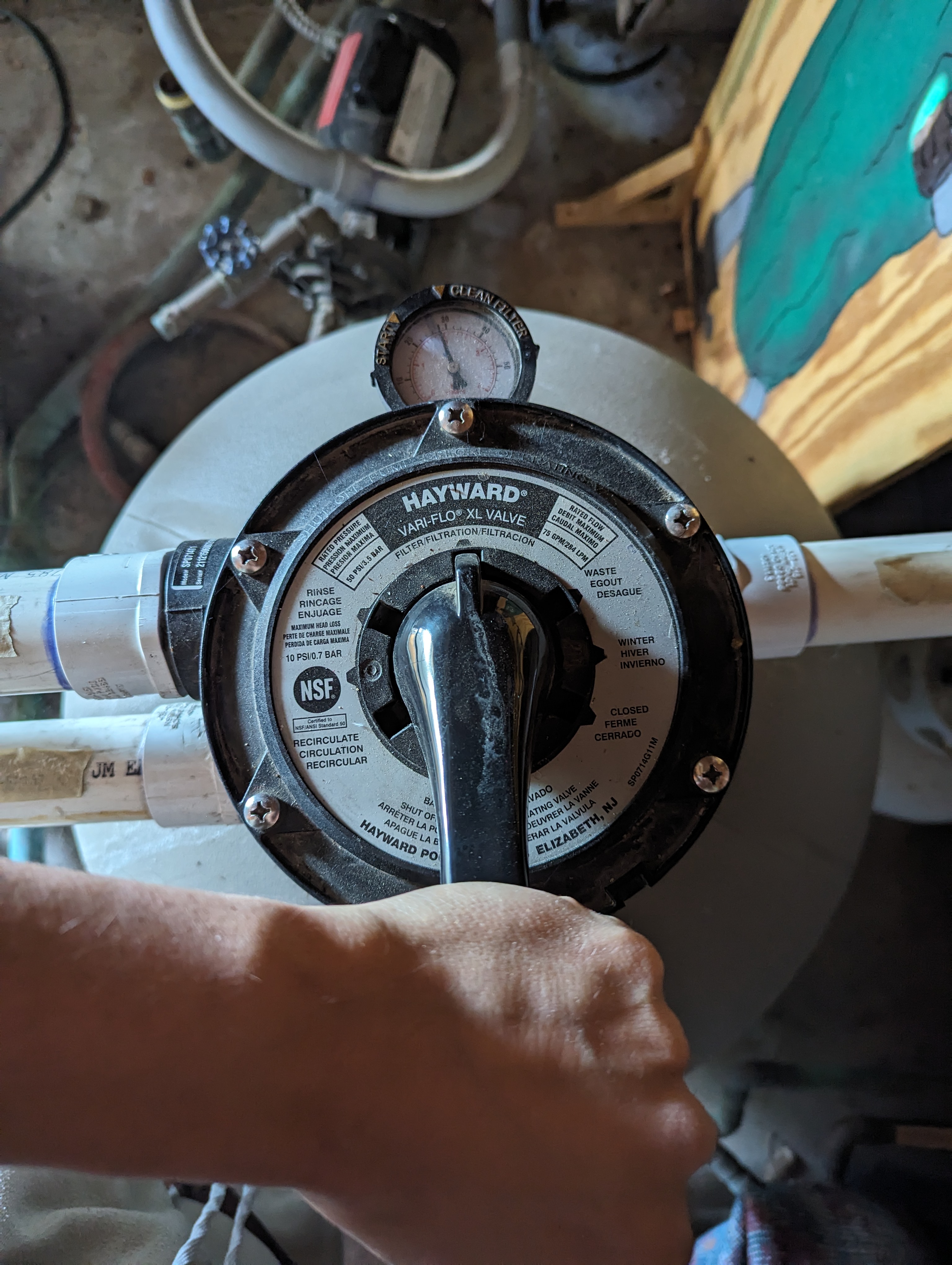
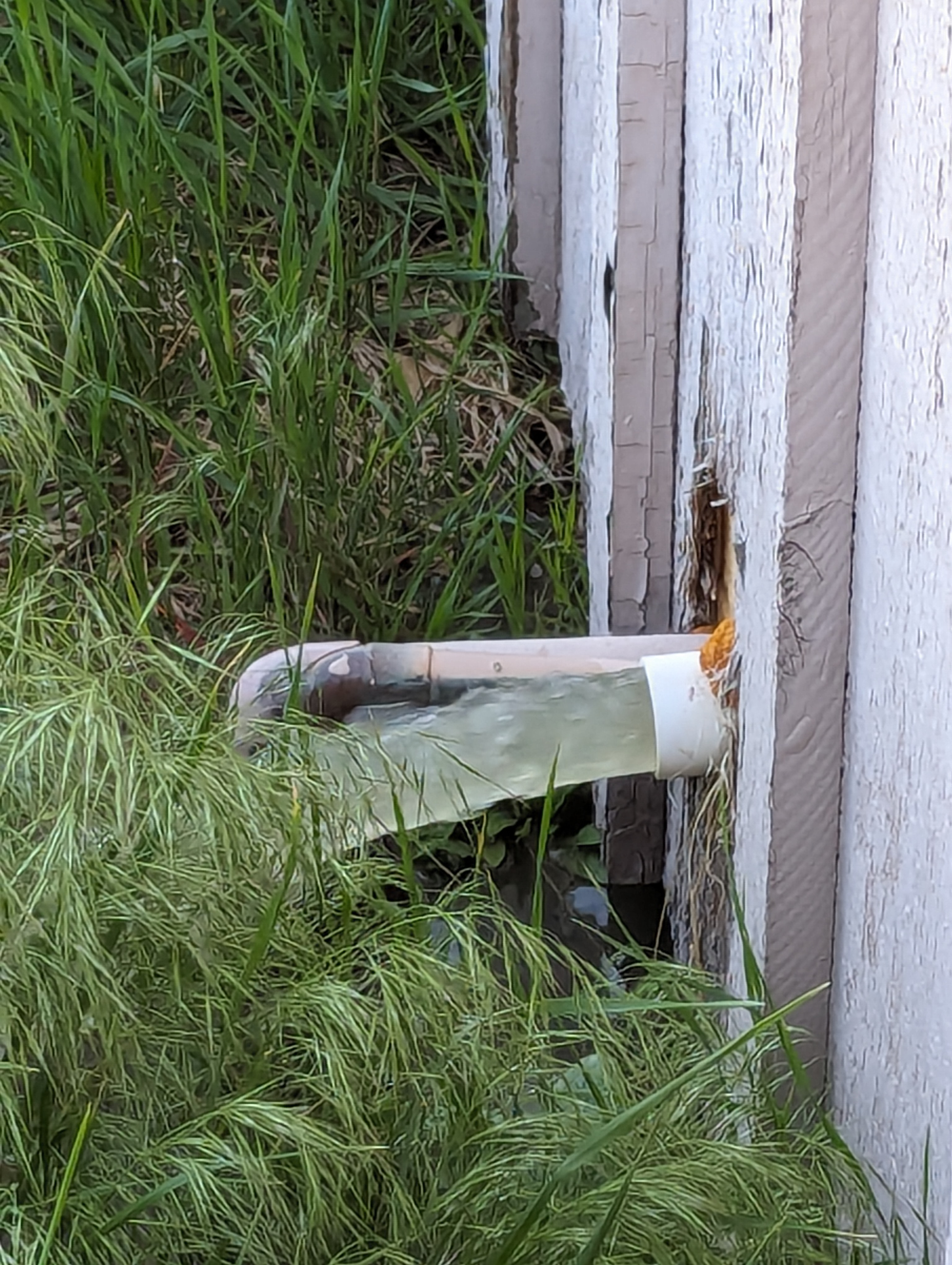
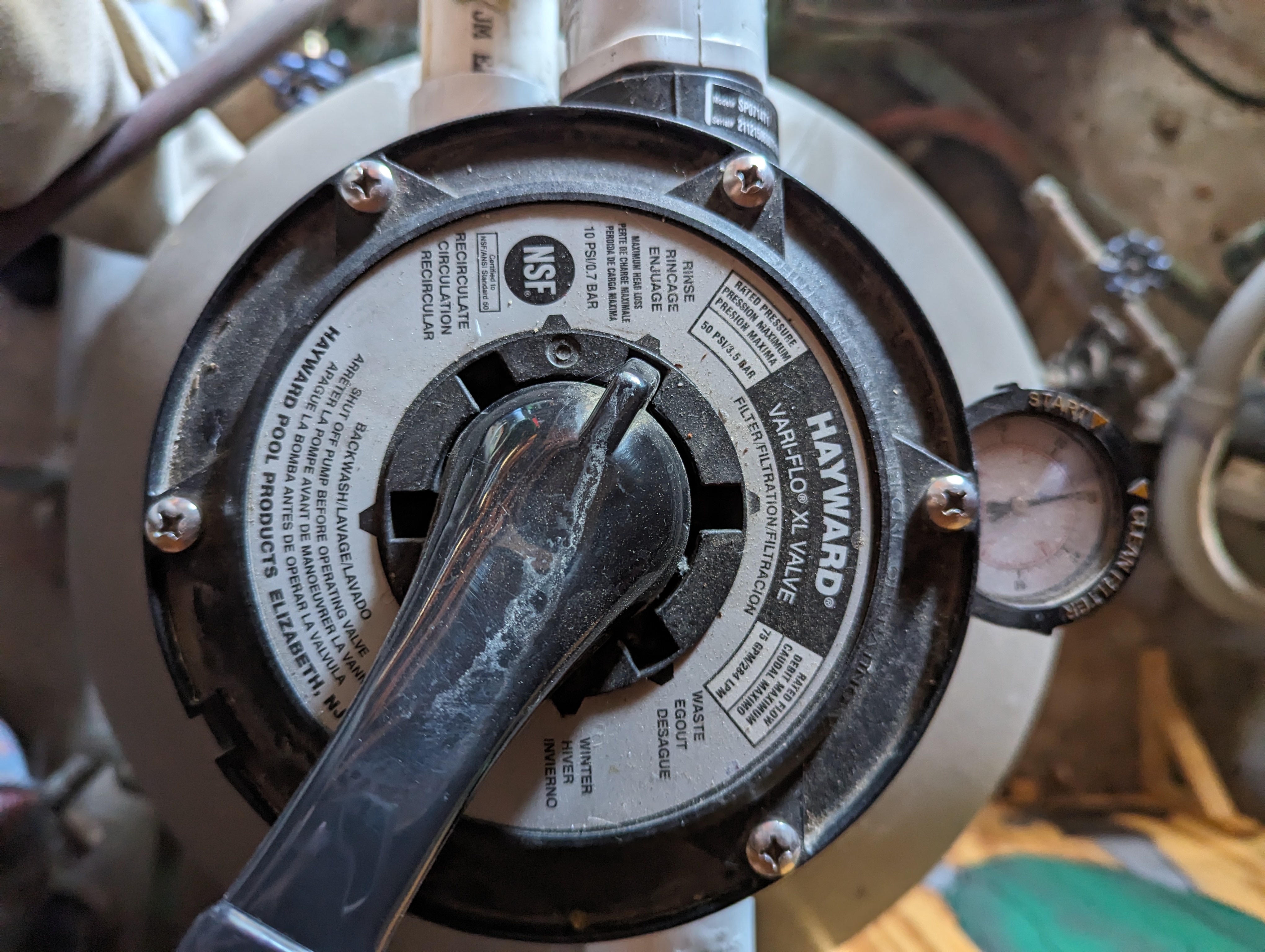
Chemical Dosing — Liquid Chlorine
Standard 10–12.5% sodium hypochlorite from pool store. Avoid tabs — each tab adds CYA, and we'll overshoot CYA fast over a Reno summer.
For 30,000-gal pool: 1 gallon of 10% liquid chlorine raises FC by ~3 ppm.
Add at deep end with pump running. Wait 30 min before re-testing.
Use Pool Math app for all other dosing (pH adjusters, TA increase, CYA addition, CH increase) — it does the math against our exact volume.
Supplies on Hand
Pool chemicals in stock + where to reorder each — update when you buy or run low. Informs dosing (what we can reach for), rebuy timing, and sourcing. ✓ = confirmed source · italic = needs owner confirmation.
| As of | Item | Source (where to order) | Notes |
|---|---|---|---|
| 260819 | Chlorine tabs | Costco ✓ | ⚠ off-method — tabs dissolve CYA into the water and creep it up over a Reno summer. Use sparingly (a floater while away); liquid chlorine is our default. |
| 260819 | Chlorine granules | Costco ✓ | Check the label: dichlor adds CYA, cal-hypo adds CH+FC. Fine for spot dosing; watch which one. |
| 260819 | Shock | Costco ✓ | For SLAM / weekly boost. Check type — cal-hypo raises CH+FC (good, our CH is low); dichlor raises CYA. |
| ongoing | Liquid chlorine (10–12.5%) | Leslie's now ✓ · cheaper leads to price-check: Elite Chlorine (bulk 12.5%, NV delivery fleet) · Oasis Pond & Pool (local Reno) | Our default sanitizer — keep stocked. 1 gal 10% ≈ +3 ppm FC in 30k gal. Bulk refillable carboys usually beat jug prices. |
| — | Calcium chloride | Cheapest = non-pool pure 94% CaCl₂ ice-melt, 50 lb (~$0.50–0.90/lb — ½–⅓ the pool price): Excel/Scotwood 50 lb (Home Depot) · Peladow 90% 50 lb. ⚠ pure single-ingredient only (no blends) · ⚠ seasonal — winter stock, often off-shelf in summer. Year-round deliverable (pricier ~$1.50–2/lb): Pool Mate 25 lb 100%. Tractor Supply (local, same-day): Snow Joe 20 lb 94% pure pellets ✓ or Safe Step 7300 ✓ — ⚠ NOT the 1 Shot dust-control brine (liquid, 35%) or Bare Ground (traction-granule blend) | Generic CaCl₂ — pool "hardness increaser" is the same chemical, marked up. Need ~20–25 lb to raise CH 188→~250 in 30k gal. Pool Math for exact dose; prices ballpark, confirm on page. |
| — | Baking soda (TA up) | Costco / grocery (commodity) | Rarely needed — TA runs in our 60–80 band. |
| ongoing | Pool RX cartridge + booster | Amazon ✓ (booster link in #Pool RX — Current Cycle) | Mineral assist, 6-month cycle. |
| ongoing | Test reagents (5-way kit) | Leslie's / Amazon ✓ | FC / pH / TA / CH / CYA refills. |
Plaster Condition
Old plaster, chipped in multiple places. Strategy:
- Brush vigorously around chips weekly (metal brush)
- Patch major chips that expose substrate with white pool plaster patch kit (~$30) before water wicks behind and cracks spread
- Maintain CH ≥ 250 ppm — prevents further calcium leaching from remaining plaster
- Plan for resurface within 1–3 years (#Future Improvements)
ToDo:: Survey chip locations; photograph for resurface quote bid documentation
ToDo:: Stockpile pool plaster patch kits for spot repairs between now and resurface
Pool RX — Current Cycle
Installed: 260514 (black/white cartridge, sized for 30k-gal pool)
Cycle end: ~261114 (6 months)
Status: active
Pool RX is a chelated copper sulfate mineral cartridge — copper ions inhibit algae. Same active-ingredient family as Simple Scoop and similar all-in-one products. Effective at reducing algae demand on chlorine but introduces a copper-staining risk that's heightened on chipped plaster (more substrate to bind blue-green/black staining if pH drifts above ~7.8).
Management during this cycle (now → 261114)
- Run the cartridge through its lifecycle — don't discontinue mid-cycle (wasteful + you've already paid for it)
- pH discipline is tighter: hold pH 7.6–7.8 strictly. Copper precipitates and stains above 7.8. Test pH every 2–3 days minimum during summer.
- Maintain CH ≥ 250 ppm — same as plaster strategy, also helps prevent copper precipitation
- Watch for staining: blue-green tint on plaster or fixtures = copper drop-out. Catch early (acid washing patches is easier than full).
- Standard chlorine + CYA still required — Pool RX is NOT a sanitizer. It only reduces algae demand on chlorine; you still need FC in target band.
Cycle renewal — 261114 (booster)
Committed: Pool RX is our chosen mineral system (owner decision 260811). Default action at the 6-month mark is to add the Booster and continue — not discontinue. (Pool RX remains a mineral assist, not a sanitizer; standard chlorine + CYA management still runs alongside it — see above.)
Safety-valve exceptions — discontinue this cycle instead of renewing only if:
- Visible copper staining appears (blue-green tint on plaster/fixtures) — stop and let copper draw down via dilution + filter capture; staining risk is elevated on our chipped plaster
- Resurface scheduled within ~12 months — minimize copper in the water before the drain
Absent either, add the booster.
ToDo:: 261114 — add Pool RX booster (default renewal); check for copper staining + resurface timing first
Algae Bloom → SLAM (the recurring fix)
When the water greens / algae blooms it's almost always because FC dropped to ~0. Run a SLAM (Shock Level And Maintain — TFP method), not tabs:
- Test FC, pH, CYA — confirm the crash.
- Bring pH to 7.2–7.5 first (chlorine works faster); keep ≤7.8 for Pool RX copper.
- Raise FC to SLAM level = ~40% of CYA, with liquid chlorine (never tabs). At CYA 38 → target ~15 ppm; ~30k gal, 1 gal 10% liquid ≈ +3 ppm, so ~5 gal from zero. Pump running, add at the deep end.
- Brush every surface (walls, floor, steps, behind fittings) — dislodges algae so chlorine reaches it. Brush daily through the SLAM.
- Run the pump 24/7. Backwash/clean the filter as PSI climbs — dead algae loads it fast (#Backwash Procedure).
- Re-test + re-dose FC back to ~15 several times a day — hold it, don't let it sag.
- Vacuum settled dead algae (to waste if heavy).
- Done only when all three pass: water crystal-clear · OCLT (overnight FC loss) <1 ppm · zero visible algae. Then let FC drift back to the normal band.
Use the Pool Math app for exact doses. ⚠ Pool RX cartridge is in — hold pH 7.6–7.8 after the SLAM to avoid copper staining on the chipped plaster.
Test Log
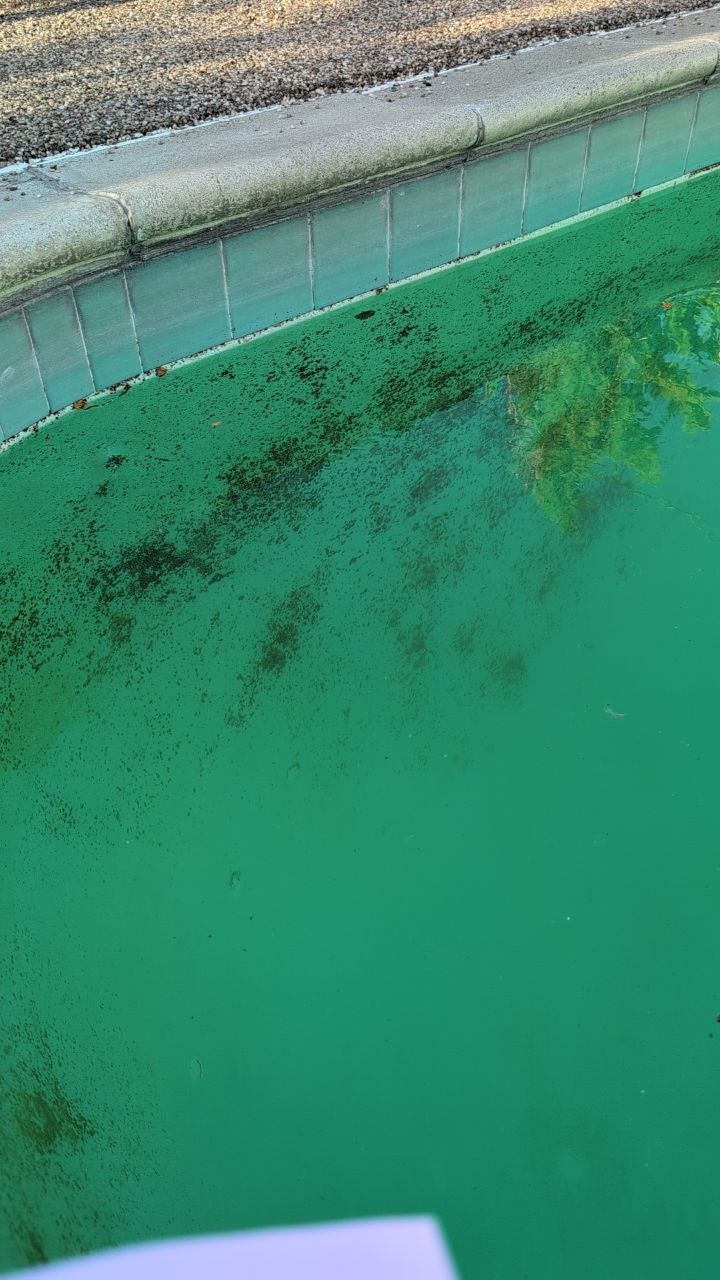
260819 — algae bloom, FC crashed → SLAM
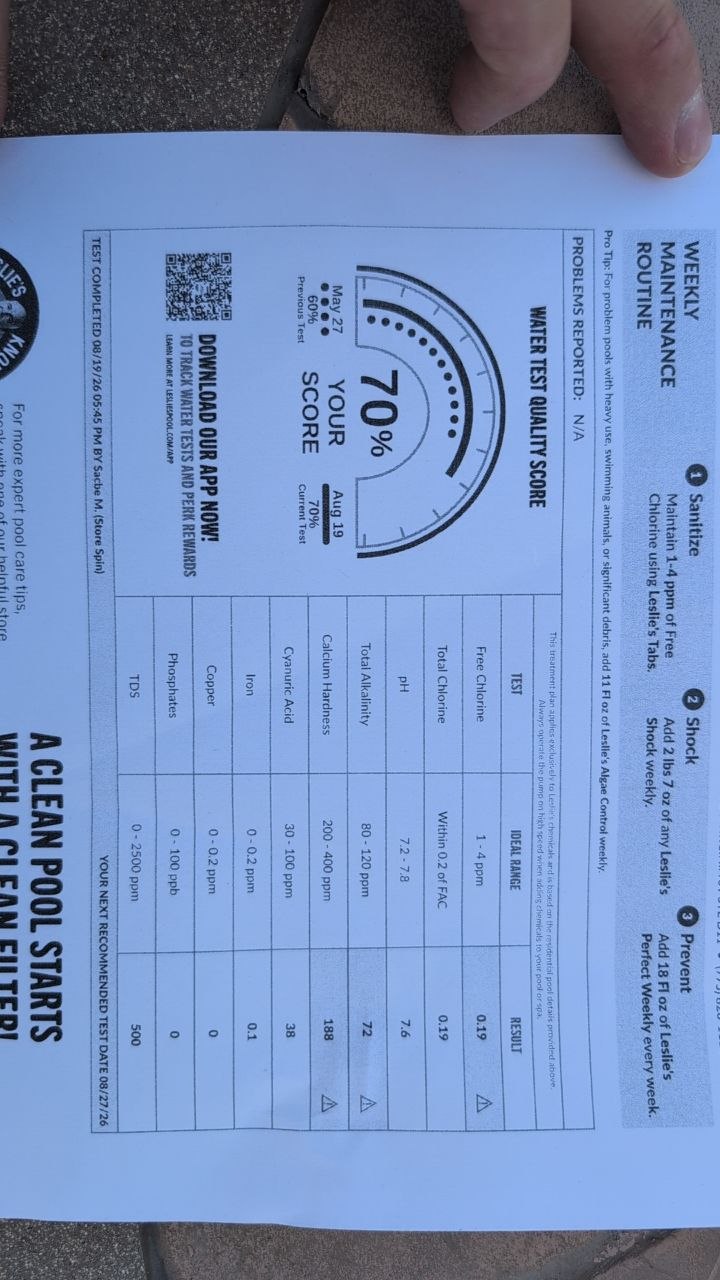
Leslie's test (Sadie M., 08/19 17:45; quality score 70%, ↑ from 60% on 05/27):
| FC | pH | TA | CH | CYA | Fe | Cu | PO₄ | TDS |
|---|---|---|---|---|---|---|---|---|
| 0.19 ⚠ | 7.6 ✓ | 72 | 188 ⚠ | 38 ✓ | 0.1 | 0 | 0 | 500 |
- FC crashed to ~0 (target ~4–5 @ CYA 38) → green water + algae on walls/floor. Root cause = sanitizer ran out.
- TA 72 is fine by our targets (60–80 for liquid chlorine) — ignore Leslie's "low vs 80–120," their band assumes tabs. CH 188 is genuinely low → raise toward ≥250 (plaster protection + reduces Pool RX copper precip) after the SLAM.
- Action → SLAM (above): hold FC ~15 with liquid chlorine, brush, 24/7 pump, filter, vacuum; then raise CH.
- ⚠ Ignore Leslie's tab/Algae-Control plan — tabs add CYA and creep it up over a Reno summer; our method is liquid chlorine + Pool RX (see #Chemical Dosing — Liquid Chlorine).
- 260819 field actions (owner): system was down → backwashed, then added 5 lb baking soda + 3 bags shock. Read against our method: 3 bags ≈ +3 ppm FC (a start, not a full SLAM ~15) — re-test in 30–60 min and top up with liquid chlorine to hold ~15 until clear + OCLT passes. If the shock was cal-hypo it also nudged the low CH upward (good). Baking soda was unnecessary — TA 72 was already in our 60–80 band; 5 lb pushes it to low-80s and pH up, so watch pH stays ≤7.8 (Pool RX copper). Confirm the pump runs 24/7 — SLAM fails without circulation.
- 260820 AM update (owner): +2 more bags shock (≈5 total), pump running 24/7, brushed — water already pretty clear. SLAM is working. ⚠ Not done yet — hold FC up and keep dosing until all three pass: crystal-clear + OCLT <1 ppm overnight + zero visible algae. Clearing water often still holds live algae that rebounds in 2–3 days if FC sags. Keep brushing daily; backwash as filter PSI climbs. Then let FC drift to normal (~5) and raise CH ≥250.
- Next test target: 08/27/26.
Seasonal Schedule
Spring — Pool Opening
Pool RX note: see #Pool RX — Current Cycle section below for current cycle status and decision points.
Summer
- Have fun in the pool 🌞
- Testing rhythm above (FC + pH every 2–3 days, full panel weekly Sundays)
- Pump 8–12 hrs/day during peak heat for circulation
- Top off water against evaporation (also dilutes mineral creep from hard tap water)
Fall — Pool Closing / Winterization
Timing: mid-October to early November, before sustained freezing temps. Reno typically hits first hard freeze early-to-mid November.
Winter
- Minimize leaves and debris accumulation on cover
- Inspect cover after major storms
- Do NOT remove cover or run equipment until spring opening
Pool Masters
Current: @Ryan, @Kevin?
ToDo:: Ask Flock who wants to be a Pool Master for next season
Q:: What is the reward for being a Pool Master?
Responsibilities:
- Testing per schedule above
- Chemical additions per Pool Math app calculations
- Backwash when PSI threshold hit
- Brush + skim
- Whiteboard updates
- Flagging plaster chip changes for the resurface tracker
Future Improvements
Pathways to simplify maintenance, ordered by investment level. Decision dependent on plaster resurface timing — automation pairs better with fresh plaster surface.
Option 1 — Manual + Pool Math app (current, dialed in)
- Cost: $0 (kit + free app already in place)
- Effort: 5 min testing 2x/week summer + manual chemical adds
- Pros: no equipment risk, works with chipped plaster
- Cons: still requires Pool Master attention
Option 2 — Stenner / Liquidator peristaltic pump (auto-dose liquid chlorine)
- Cost: ~$250–400 setup + monthly liquid chlorine (~$30/mo)
- Effort: refill chlorine tank monthly + testing
- Pros: removes "did anyone add chlorine?" question; cheap; robust; no copper or CYA buildup
- Cons: still need to manage pH/TA/CH/CYA manually; tank refill chore
Option 3 — Saltwater chlorine generator (SWG)
- Cost: $1,500–3,000 install + ~$700 cell every 5–7 yrs + initial salt (~$200)
- Effort: weekly testing only; system makes chlorine from salt
- Pros: huge effort reduction; gentler on skin/eyes
- Cons: may accelerate failing plaster if chemistry drifts; pair with resurface, not before
Option 4 — Full automation (ORP/pH controller + auto-chlorinator)
- Cost: $1,500–3,500
- Effort: monitor sensors; sensors drift, need recalibration
- Pros: nearly hands-off
- Cons: complex; sensors need maintenance themselves; overkill for an old pool pre-resurface
Plaster Resurfacing
Realistic horizon: 1–3 years.
Budget estimate (30k-gal pool, Reno area):
- White plaster (basic): ~$5,000–7,000
- Quartz finish (mid-tier): ~$7,000–10,000
- Pebble finish (premium, most durable): ~$9,000–14,000
Reno contractor leads — call for quotes:
| Contractor | Notes |
|---|---|
| Adams Pool Specialties | Reno, in business since 1953; pebble finish work; well-reviewed. Search "Adams Pool Specialties Reno". |
| Generation Pool | Reno; clean job sites, well-reviewed. Search "Generation Pool Reno". |
| Prestige Pool/Spa | 4.8/5 rating (small sample, verify). |
| ASP – America's Swimming Pool Co. of Reno | National franchise, broad service. asppoolco.com/reno |
Process:
- Schedule 2–3 site visits for quotes
- Verify each contractor's NV contractor license + insurance via NV State Contractors Board: nscb.nv.gov
- Ask each for: surface choice (white plaster vs quartz vs pebble), prep extent (full chip-out vs spot patch), warranty (typically 2–5 yrs), startup chemistry included
- Decide finish type — cost vs durability tradeoff
- Schedule for off-season (late fall after closing, or early spring before opening)
ToDo:: Call top 2–3 contractors for site visits; collect quotes
ToDo:: Photograph chip locations + dimensions for accurate bids
ToDo:: Verify license + insurance via nscb.nv.gov before signing
ToDo:: Decide finish type before committing